Septic Tank Diagram: How the System Works from Tank to Drainfield
A septic tank diagram shows how household wastewater travels from the home to a buried tank, then through a distribution system to the drainfield. In a typical conventional system, solids settle in the tank, liquid effluent leaves through an outlet, and the soil beneath the drainfield provides more treatment. The exact layout depends on the system design, property, and local regulations:
One thing I hope this diagram does is make septic systems feel less mysterious. Most of the system is underground, so it helps to follow the wastewater step by step: from the house, into the tank, and out to the drainfield. Once you see how those parts work together, it’s easier to understand why each one matters.

Key takeaways
- Household wastewater flows from the home’s plumbing into a septic tank.
- Heavy solids settle at the tank bottom. Grease and other light materials float to the top.
- An outlet tee or baffle helps keep solids from leaving the tank.
- Some systems have an effluent filter. Not all tanks have the same parts.
- A distribution box or another device directs liquid to the drainfield.
- Soil beneath the drainfield provides further treatment. It does not make the water safe to drink.
- A typical illustration cannot confirm the location or design of your own system.
Which system layout does your home use?
The flow path below describes a conventional, soil-based system. Some homes use pumps or added treatment units, so their equipment and flow path may differ. The U.S. Environmental Protection Agency’s overview explains the main stages and notes that alternative systems may use added treatment or different ways to move wastewater.
| Common setup | How liquid moves after the tank | What may appear in the illustration |
|---|---|---|
| Conventional gravity system | Gravity carries effluent toward a distribution device and drainfield | Tank, outlet, sometimes a distribution box, and drainfield lines |
| Pump or pressure system | A pump moves effluent from a pump chamber or tank to the field | Pump chamber, pump, control or alarm, and pressure lines |
| Alternative treatment system | Added treatment may occur before discharge to the soil area | An aerobic unit, sand filter, mound, or other approved equipment |
Affiliate disclosure: This post contains an affiliate link, which means I may receive a commission if you purchase through my link at no additional cost to you.
Check out the product info for Septifix if you’re doing research on septic tank treatments. This is just an advertisement link and not a review. Always follow your septic system’s schedule and consult with your septic pro if you have any questions about using a product on your system.
Septic Tank Diagram: Follow the Flow
A typical conventional septic system moves wastewater through this sequence:
Home drains → inlet pipe → septic tank → outlet tee or baffle → distribution box, if used → drainfield → soil
These arrows represent the path of the wastewater. Distances, depths, and slope are not shown on this diagram. Depending on the site, type of system, and local requirements, the configuration and components can change. You may have no distribution box or other treatment devices. Refer to your system drawings or consult with a licensed septic contractor to verify what you have on your property.
1. Household plumbing carries wastewater outside
All of your household waste travels through your home’s main building sewer line. Your house waste can include toilet, sink, shower, and clothes washer discharge, etc. This waste will lead to the tank.
In most cases, gravity will take care of this portion of the journey. Some systems may require a pump if the lot is on an incline or if the system is designed differently. Your illustration should show your home-to-tank connection as just a pipe, not something that can be pinpointed on your property.
If you do not know where your tank is located, there are some steps you can take to help you. This guide explains how to find your septic tank without digging up the yard.
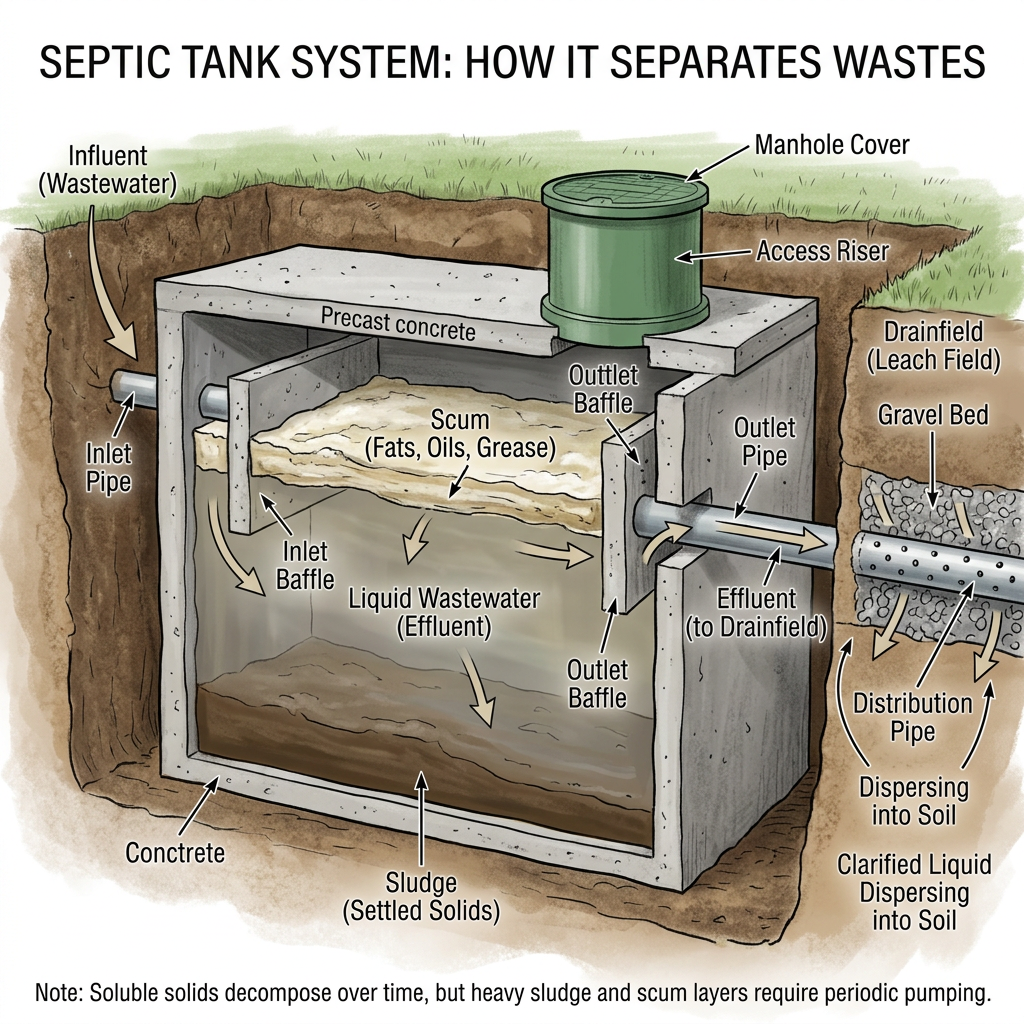
2. The tank separates solids from liquid
House waste enters the tank through the inlet. The tank allows your waste to sit long enough for some separation to occur.
Heavier solids will drop to the bottom of the tank and become sludge. Lighter solids will rise to the top of the tank and become scum. The liquid in between these two layers is called effluent.
Bacteria will help digest some of your organic matter, but not all of your solids, and it will not make the water potable. Over time, your sludge and scum layers will grow, which is why you need to have your tank inspected and pumped when needed.
The tank can consist of multiple chambers and be made from various shapes and materials. Your illustration should represent these layers, but they should not appear to be perfect layers within your tank.
3. The outlet limits what leaves the tank
Effluent will leave the tank through an outlet. Usually, an outlet tee or baffle will stop some of the scum and sludge from exiting the tank. This is important because any solids that get out of the tank can clog the rest of your system.
You may also have an effluent filter located at the outlet. This will allow even more solids to be trapped. Not all systems have filters, and there are many types of filters and maintenance. Learn More About Septic Tank Effluent Filter Cleaning.
Never try to remove a filter or look inside your tank. Leave this to the professionals. Tank lids can be very heavy and dangerous if you get your hands under them.
4. A distribution device routes effluent
Once effluent leaves the tank, it will travel to your drainfield through a pipe. Most gravity-fed systems will have a distribution box that feeds each of your lines. Sometimes this is referred to as a D-Box.
There are many systems that do not use a D-box. They may use a manifold, pump, or some type of pressure distribution. Your illustration may not apply to your situation if you have a D-box.
Your distribution box is simply there to help distribute your waste. It is not going to treat your waste in any way. If your distribution box is sitting crooked, it can cause one of your lines to receive more waste than it should. What Does a Distribution Box Do? Read more about what a distribution box does and signs it may need attention.
5. Drainfield lines release effluent into the soil
Also known as your soil absorption area or leach field. There are many types of lines that can be used for your drainfield, but typically you will have lines in trenches.
Your lines will allow your waste to slowly leave the pipes and enter the ground. The ground must have the proper soils to allow your waste to pass through. If the ground is saturated, your waste may not be able to travel as it should.
According to the University of Maryland Extension, your wastewater will leave your septic tank and go through your distribution box into the ground. Your lines will be in trenches filled with gravel.
Your drainfield can vary in size and shape. Make sure to know what you can and can’t do around your drainfield. How To Take Care Of Your Septic Drain Field.

6. Soil provides further treatment
Your ground will continue to treat and help disperse your waste as it travels through the soil. This depends on the type of soil you have and the water table in your area.
Again, there is no way to determine this from a drawing. Your ground may or may not be treating your waste properly and keeping your well clean. Always test your well and speak to your health department if you have any concerns.
How to read the illustration without overreading it
You can use a general picture to help you understand the order of components in a septic system. It will not tell you where to install a system or where your lines may be located under your property.
Things to Know About the Picture
- Direction of flow: Arrows should lead from the home toward the tank and then toward the soil treatment area.
- There should be arrows pointing from your house to your tank and then out to the ground.
- Your tank should be labeled with “scum layer,” “liquid effluent,” and “sludge layer.
- There should be a tee or baffle at your outlets. Some pictures may show a filter, but this is only if it’s noted as an option.
- There should be some sort of distribution device, such as a D-box, manifold, or pump. These are all different and are not interchangeable.
- The picture should show your field as a treatment area, not a sewer line or source of drinking water.
- It should state that your layout may differ and is not drawn to scale.
Your picture should also indicate what is buried. You can show the path of the waste but not give the impression that the average homeowner should know how to dig up their system.
What a general drawing cannot tell you
You can’t assume your picture will show what is at your home. It could be missing your pump, alarm, reserve field, additional treatment unit, etc. Depending on your system’s age, it could be different from what is installed today. Repairs to your system may have altered it as well.
Your picture also will not tell you:
- Where your tank, lines, and field are located.
- The size of your tank or the age of your system.
- If your tank has a filter at the outlet.
- If your field is functioning properly.
- If your system meets current codes in your area.
- If your well or other source of drinking water is safe.
You can find more specific information about your property by locating your septic permit, plot plan, or any records that were made when the system was installed or serviced. Your local health department or permit office may have a copy of these records. If you can’t find your records or are unsure of what is installed, have a septic professional come and take a look at your system. There is only so much information that can be obtained by an inspection of the tank and accessible components of your system. Records or an evaluation of your site will tell you what was allowed on your property. The blog’s septic inspection checklist and guide explains what an inspection may cover.
Safety around septic tanks
Pictures can be used to show you how your septic system works but should not be used to try and open any of the components. Never enter your septic tank. Do not stick your body over an open tank or leave your lid open. According to the EPA, your septic tank should only be cleaned or repaired by professionals who are trained to do so. Your tank may hold toxic gases that can harm you. Call a septic professional to service your system.
Avoid coming into contact with your waste. If waste does get on you, wash your hands with soap and water. Flush your eyes with a safe source of water if waste gets in your eyes. According to the CDC, if you come into contact with human waste, you should bandage any open wounds and seek medical attention if you feel sick. Always let your doctor know if you have been exposed to sewage and seek immediate medical attention if you feel extreme symptoms or shortness of breath after coming into contact with gases from your tank.
Conclusion
As you can see, a septic tank diagram is just one piece of information that can help you understand how your septic system works. There are many things that can vary from home to home. Use the diagram to gain knowledge on how your system works and not to locate or repair your system. Always check with local records or a septic professional for information on your home’s system.
FAQ
Do all septic systems have a distribution box?
Not all systems will have a distribution box. Some conventional gravity systems will, while others may have a manifold, pump, or other form of distribution. Refer to your home’s information or consult a septic professional.
Are there effluent filters on all tanks?
Some tanks will have a filter; others will not. The presence of a filter on your tank depends on your specific system.
What are scum, sludge, and effluent?
Scum is composed of grease and lightweight materials that float to the top. Sludge consists of solid materials that have settled at the bottom of the tank. The liquid between these materials is called effluent.
Can I use this drawing to locate my tank?
This drawing illustrates how most systems are designed; it will not show you where your equipment is located on your property. Use your permit or installation records to locate your system, or have a professional locate your equipment.
Can I touch liquid that comes from my septic tank?
Septic system liquid should be treated like any other sewage. Do not touch the liquid that is coming from your septic tank. Once the effluent leaves your tank, it will continue to be treated in your soil. However, do not consume liquid that is coming from your septic tank.
What if I get sick from touching sewage?
If you become sick after coming into contact with sewage, see a medical doctor and explain what happened. The CDC has listed many illnesses that can occur when exposed to human waste. Vomiting, stomach cramps, and watery diarrhea are some signs to prompt a doctor’s visit if you are working with human waste.
Final Thoughts
Hopefully, this guide give you an idea of how a septic system is laid out. Most properties will have their waste leave their house, go into the septic tank, then into the drain field or some other type of treatment system. It can be helpful to know where these are located on your property.
However, there are many different types of septic systems and layouts that will depend on your property. If you have any information about your system’s type or know where your permits were placed, you can use that to help figure out what pieces your system may have.
If you need to repair or know what may be going on with your septic system, call a professional. Having some basic information will allow you to better understand what you may need to do and how to take care of your septic system.
Want to check out something else? Here is an advertisement for Septifix, which you can read about below. Make sure to read through everything to see if it’s right for you.

Related Posts