Septic Drainfield Pipes: Types, Layout, and How Professionals Find Damage
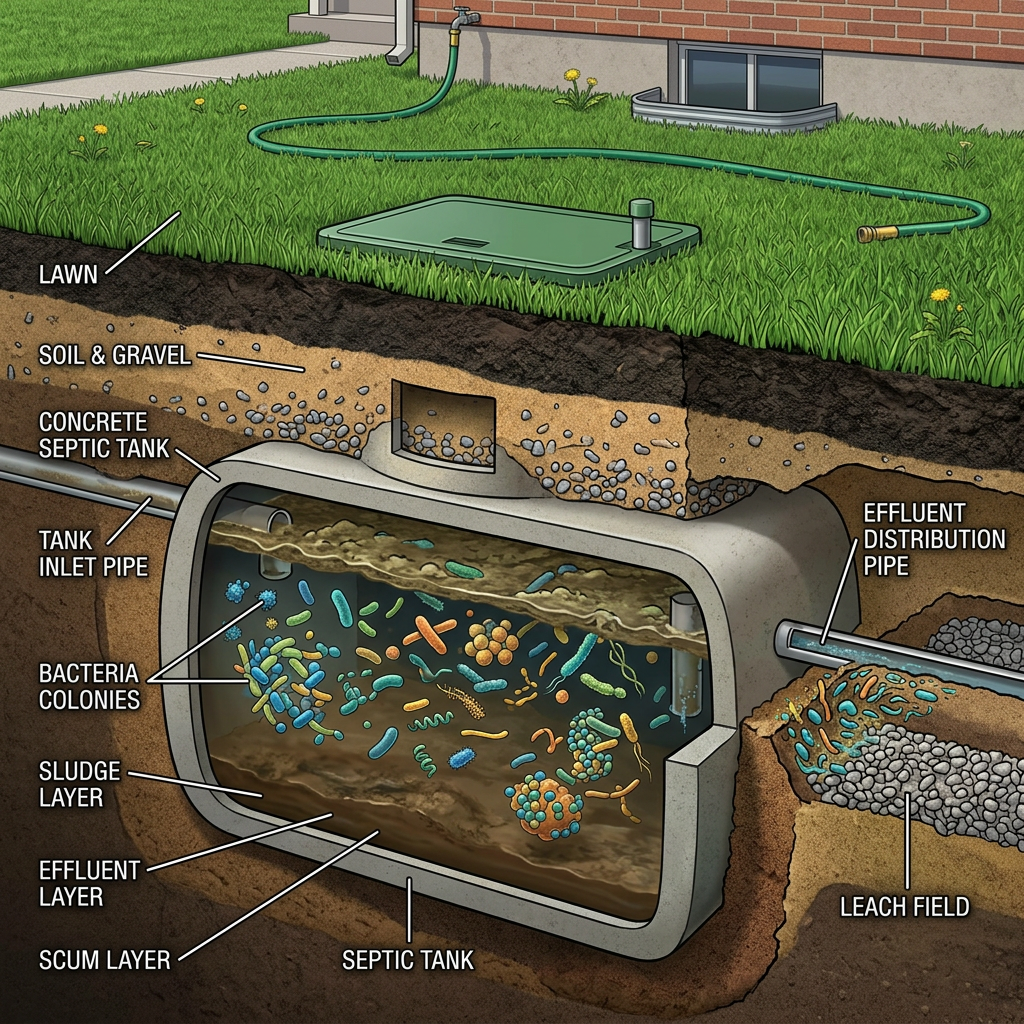
Septic drainfield pipes will take wastewater from the septic tank and direct it to the ground. There are pipes that will feed wastewater from one part of the system to another. They will also feed it out into various trenches or chambers.
Depending on the design of the system, as well as the property and regulations, there will be different configurations. Traditional systems will have a gravel trench with distribution boxes and perforated pipe. Chamber systems will have chamber units instead of a gravel bed. Pressure distribution will utilize a pump to send wastewater through various lines. These can all be combined with each other, and pressure distribution can be used with any soil absorption system.
This will allow you to better understand your system when looking at a system plan. Or, if you have questions about your septic inspection, you can ask your inspector about these items.
The thing I really like is how much of a septic drainfield is underground. Seeing the pipe layout gives me a better idea why a drainfield installer will want to check and locate his lines before he probes or digs.

Key takeaways
- Solid pipes typically convey waste to the drainfield. Perforated lines or chambers distribute waste to the soil.
- There are variations with gravel trenches, chamber systems, and pressure distribution. Pressure distribution refers to how waste is distributed and could be used with any drainfield configuration.
- Site plans will give you a general idea of what your layout should be. They do not confirm that all buried piping is where it should be.
- You can get different information from records, accessing your system, using locators, and video scoping. There is no one method that will verify everything about a buried system.
How wastewater reaches the drainfield
Once waste leaves your house, it will travel to the septic tank through your building sewer. After entering the tank, solids will drop to the bottom or rise to the top. Liquid will pass through to the outlet of the tank. It will then travel through a solid pipe to the next stage of the process.
This could be to a distribution box, pump chamber, manifold, or something else depending on your system’s design. It will then enter the drainfield trenches or chambers. Waste will then pass through to the soil, which will provide additional treatment. According to the EPA, this is where the waste will be dispersed into the soil for further treatment (How Septic Systems Work – EPA).
Depending on the system, the waste will travel in different ways. Gravity systems will depend on how your piping is set up. Pressure systems will depend on your pump and pressure piping. A professional should be able to tell you what your system is designed to do and what the pipe/access is doing for you.
Two different jobs: carrying and distributing wastewater
Pipes that convey waste to your drainfield are usually solid lines. This could be from your tank to a distribution box, or from a pump chamber to your drainfield if you have a pumped system.
Perforated pipes are used to distribute waste to the soil absorption area. With a traditional gravel trench, your perforated pipe will allow waste to pass through the open ends and slits in the pipe. Chamber systems allow waste to enter the chambers and then pass through to the soil. Pressure distribution uses a pump to distribute waste to the soil absorption area.
Just because you see a solid pipe doesn’t mean it’s conveying waste. It could be distributing waste depending on where it’s located in the system. Always make sure you know what you’re inspecting and what it does for your system.
How the three layouts differ
| Layout | How wastewater reaches the field | What is arranged in the soil |
|---|---|---|
| Gravel trench | Usually flows by gravity through a solid pipe to a distribution box, then into branch lines | Perforated pipes sit in gravel-filled trenches |
| Chamber trench | A solid pipe carries wastewater to the chamber area; the exact inlet arrangement depends on the design | Molded chambers sit in trenches and replace the gravel bed in many designs |
| Pressure distribution | A pump sends wastewater through a force main to a pressure network | Smaller distribution lines release wastewater through openings across the designed area |
Gravel trenches
Typically, there will be a solid pipe leading into a distribution box. This box will have multiple outlets leading to lines that go out to the leach field. The line(s) will consist of a perforated pipe that will allow effluent to drain out into the trenches. These trenches are filled with gravel to allow room for the effluent to pass through before getting to the soil.
There is usually a distribution box on these types of systems. Knowing where the distribution box outlets are going can allow you to know how your field is set up. Keep in mind there may not be a distribution box, or it can be hard to locate. Make sure you have documentation to back this up as well.
This is an example of a conventional system as explained by the EPA and University of Maryland Extension. Depending on where you are and when the system was installed, you may see different things used.

Chamber trenches
When a chamber is used, it replaces the gravel in the trench. The chambers are formed by a molding product. Wastewater will flow into the chambers and percolate through openings into the surrounding soil. Chambers can be thought of as an alternative to gravel in the trenches.
There will still be a pipe that conveys solids to the drainfield area. How the drainfield is set up will vary depending on the plan. There may not be a distribution box or laterals with holes like a typical gravel system. By looking at the plan and any components you can access, you can determine where the waste is flowing into the chamber.
Pressure distribution
Wastewater flows from a pump chamber to the distribution network via a pump. There are openings in the distribution network that will allow waste to be spread throughout the field. A pump and controls and lines run under pressure.
There can be pressure distribution with trenches or any type of drainfield that allows waste to percolate through the soil. It’s just a way to distribute the waste. So keep that in mind when you are reading your plan. You could have pressure distribution that feeds into your drainfield that may have chambers or another product installed in your trench. The Washington State Department of Health’s system overview describe gravity and pressure systems and their components.
What shapes a system’s layout?
Your plan will dictate where your drainfield area is. Soil and space will play a major role. Slope and drainage can also affect where the drainfield area will be, as well as buildings and objects on the property. What your local health department will allow on your property.
This is why you could have two properties that both have the same size tank. But one may have a distribution box and gravity-fed drainfield. One may require a pump to feed into the drainfield, and one could have chambers instead of gravel trenches. Using a plan can give you some idea of what is on your property, but you should have someone who knows your local health department’s rules come look at your property.
For more on how design and site conditions relate to drainfield area, see the existing guide on how big a septic drainfield should be.
Components that may be accessible
Depending on what system you have, there are some things that are accessible to you: access to your tank, distribution box, pump chamber, controls, cleanouts, and possibly inspection ports. You may or may not have all of these on your system.
Using these items, a pro can determine what is accessible to them. If there is a distribution box, they can open it up and see what lines are going out of the box. Maybe there is a pump chamber where they can gain information on your system, or an inspection port that leads to something on your system.
Just because you can access something doesn’t mean you know everything about your system. If there is an outlet going out of your distribution box, you don’t know where that line goes, or how long it is, or what shape your drainfield is in.
How a professional traces a buried line
Most professionals will use records and fieldwork together. Here is a general idea:
- Review the records. A homeowner gives you a permit or as-built that shows a tank distribution box and three lines to a drainfield. A professional would look at the plan and see what date it was made. They can then look at the plan’s landmarks and compare them to what’s on the site today.
- Find an accessible component. In this case, the pro would try to locate the distribution box using the plan and field landmarks. If able, they would open the box and inspect it.
- Check the connections. This can help determine if the lines leave in the correct location based on the plan. There could be many reasons why this doesn’t correlate to the plan. Not all plans are complete, or the system could be different than what is shown on the plan. Or you may just need to dig into the issue more.
- Use a suitable locating method if needed. Depending on the situation, you could use an appropriate locating device or camera and locator. This will depend on your pipe size and ability to access the line. You can use a locator to see where your device or camera head is traveling. You are not always going to be able to find each lateral or know what your drainfield is doing.
Maybe your plan has your box located west of your tank, but there is no distribution box visible on your property. You could use the plan and your accessible points (tank/lines) and a proper locating device to help find the box. Once the box is located, you can look at where the lines are leaving the box to find the beginning of your lines, which can then be compared to your recorded information.
Again, this is just one method to help find your lines. Not everything can be found. Plans can be incomplete, some points may not be accessible, and your devices can only give you so much info. The EPA recommends checking system records and contacting local authorities for information about septic systems and qualified service providers (A Beginner’s Guide to Septic Systems).
What each inspection method can confirm
| Method | What it can help confirm | What it cannot confirm by itself |
|---|---|---|
| Permit or as-built records | The planned design, component locations, and intended route | That the system was built exactly as drawn or that its current condition is unchanged |
| Visual check of accessible components | What is present at the access point and how visible connections are arranged | The full route or condition of buried lines beyond that point |
| Locating equipment | The position or direction of a trackable tool, signal, or camera head | The complete route of every pipe or the condition of the soil |
| Camera inspection | The visible interior of the pipe section reached by the camera; some blockages or structural issues may be visible | Soil absorption, every part of the system, or lines the camera cannot reach |
| Pump and control checks | Whether accessible equipment and controls operate as observed during the inspection | Whether wastewater is distributed evenly throughout the entire field |
The inspection method should match the question being asked. If a professional needs to identify a line, records and locating tools may help. If the question concerns a particular accessible pipe section, a camera may provide useful interior images. If the system uses a pump, checking the pump and controls may be relevant. These methods answer different questions.

What a camera can and cannot show
Cameras can be inserted into pipes, allowing you to see what’s inside them. If you can gain access to enough piping, and the system allows the camera to travel certain lengths, you may be able to identify blockages or issues within that length of pipe. Cameras are one of the methods listed by the EPA for inspecting piping and leach lines.
Cameras will not tell you if your soil is properly accepting wastewater. They also may not be able to access all branches of piping and/or chambers. Just because a professional is able to put a camera in your system does not mean they have inspected your entire field.
Confirming a suspected problem
If you or the professional believe there is an issue with your drainfield, you will want to know more about the design of your system and figure out what portion of the system you may have a problem with. This could consist of researching information on your system, gaining access to portions of your system, watching your pumps or controls (if applicable), or using a camera and/or locating device.
Information obtained from one source may need to be verified by another source. An example would be a plan that shows where your line is supposed to be, and using a locating device to see if you can trace the path to something that you have access to. Then you could insert a camera into that portion of pipe and view what’s inside.
If there is a concern that needs to be addressed with your system, a septic professional can inform you what may need to be done and if your local health department/permitting office needs to be involved. Please refer to our existing septic drainfield repair guide for that topic.
Never enter your septic tank
Never enter your septic tank. There are harmful gases and other dangers associated with entering a confined space. Never dig to try and find a pipe or access to your system.
Call 811 before digging. Check with your local requirements before digging. Depending on where you live, the 811 process may vary and may not mark your privately owned septic lines. Ask your 811 office or septic authority what they will mark. A professional can also let you know if a private locating service will be needed.
Related septic-system guides
The mound septic system guide covers a different type of system design. Read it alongside this article if the property has a raised or mound-style field. The separate drainfield sizing guide discusses design area, while the repair guide covers repair questions.
Conclusion
Your septic drainfield can contain pipes that are used to deliver wastewater to your soil absorption area. Some pipes are used to split wastewater or can help distribute wastewater to your soil. Gravel trenches and chambers can both be used to deliver wastewater to your soil. Some systems may use pressure to deliver wastewater and may contain these methods as well.
You can use records, access to your system, a locating device, and/or a camera to learn more about your septic system. Have a professional review your system and inform you what they are able to verify with your system.
FAQs
What is the difference between a septic tank pipe and a drainfield pipe?
There are many types of piping that can leave your septic tank. Some will take you to another part of your system and others will be used to deliver wastewater to your drainfield. Depending on your system, these can be lines or chambers.
Do all drainfields have perforated pipes?
No, your drainfield may have pipe in it, but it doesn’t always have to be perforated. If your drainfield is a conventional system with gravel, then most likely you will have perforated pipe in your trenches. Chambers will have a chamber in place of gravel. If you have a pressure system, your system is designed to work with that soil absorption area.
Does a pressure system use the same layout as a gravity system?
No. Pressure systems will have a pump and are designed to work under pressure. Gravity systems rely on how your system is built out. Pressure can be used with various types of drainfields.
Can I locate drainfield pipes from the surface?
There are things that you can look for that may lead you to believe where your lines are. But again, you may not have access to your full system. Speak with a septic professional to see what options you may have.
Can a camera find every drainfield pipe?
No. As stated above, you can only see what a camera can reach. It will not help you find all of your pipes in your drainfield.
Can a camera confirm that the soil is absorbing wastewater?
No. A camera will show you the inside of your piping that it can access. It will not show you if your soil is working properly.
Will an old septic plan show the current pipe locations?
It will show you where your lines should be. Just because you have a plan doesn’t mean your system will be exactly how it was built out. Speak with a professional to see what they can find out about your system.
What is a distribution box?
A distribution box will take wastewater from your tank and feed it into your lines that lead to your drainfield. It can help you figure out how your lines are running, but will not give you all of your information.
Are chambers and gravel trenches the same thing?
Both can be used to absorb wastewater into your soil. They just have different ways of doing it. As mentioned above, a gravel trench will typically have perforated pipe in it with gravel around it. Chambers are made up of chambers that can take the place of gravel.
Should I dig to find a septic pipe?
No! Call 811 before you dig and check with your local laws. A septic professional can help you locate your lines if needed.
Who can inspect septic drainfield pipes?
Speak with a septic professional that knows about your system. Your local health department or permitting office may be able to help you as well.
My biggest takeaway: drainfield pipe layout varies—no single way to locate it can get you everything you want to know. An experienced professional can piece together the records and inspection techniques to really fill in the story.

Related Posts