How to Find Your Septic Tank Without Digging Up the Yard
If you’ve recently purchased a new home, or if you need to arrange for routine septic maintenance, you will most likely be asked one (simple) question: “Where is the location of my septic tank?”
While some buried septic tanks may have visible access lids on top of them, many other septic tanks will have their lids buried under lawn, dirt, mulch, or various types of landscaping. Additionally, older homes may not have clear documentation of the septic system’s original installation or configuration; therefore, an original tank that has been repaired/replaced, or relocated during repairs may no longer be in its original location.
If you need to know how to find your septic tank, begin by searching local property records prior to digging up the yard. Before beginning a thorough search in your yard, follow this process:
1. Search local property records
2. Follow the route of plumbing from your home
3. Look for evidence/indicators in the yard
If these methods do not result in identifying the location of your septic tank, a professional in the field can locate it using specialized equipment.

Key takeaways
- Check your local health department for a septic permit or site plan to determine if there is an as-built drawing which may show where the tank and drainfield are located.
- Look for a sewer cleanout near the outside wall of your home.
- Follow the likely route of the main sewer pipe towards the yard.
- Do not confuse the septic tank with the drainfield.
- Call 811 before probing, digging or disturbing soil in any way.
- A septic professional will use electronic location equipment and other specialized tools to find the septic system.
- Never enter a septic tank or leave an open lid unattended.
- Mark the tank location after you have found it.
1. Confirm that the property has a septic tank
First, confirm that the home uses a private septic system.
Some properties have both a private well and a septic system. Other homes may use a public water supply but still rely on septic for wastewater treatment. Rural properties are more likely to use septic, but location alone does not confirm how the home handles wastewater.
You may have a septic system if:
- You will be responsible for maintaining your own private wastewater treatment system; as such you will not have a monthly sewer charge.
- When I looked at your property record there was no indication that this property is connected to the municipality’s public sewer service.
- The property listing indicates that it has either a septic tank (or other type of private wastewater treatment) and/or a drainfield.
- As previous owners of the property, they were responsible for having the septic tank(s) emptied by a certified professional.
- You also indicated that your county health department has an active septic permit for the property.
The U.S. Environmental Protection Agency explains how septic systems work, including the role of the tank, pipes, soil, and drainfield.
If you are unsure, contact your local health department or environmental health office. Ask whether the property is connected to public sewer or has a private septic system.
2. Search for the septic permit
The septic permit is often the most useful source of information. Depending on your location, it may show the tank, drainfield, house, well, property lines, and required setback distances.
Contact the office that handles septic permits in your area. This may be:
- The county health department
- The local environmental health department
- The building or planning department
- The public works department
- A regional wastewater authority
Ask for the property’s:
- Septic permit
- Site plan
- As-built drawing
- Record drawing
- Installation permit
- Final inspection report
Different offices may use different names for the same type of document.
Have this information ready when you call:
- Property address
- Parcel number
- Tax identification number
- Current owner’s name
- Previous owner’s name
- Approximate construction date
- Permit number, if available
Some local offices provide online records. Others may require an email, phone request, public records request, or in-person visit.
What is an as-built drawing?
An as-built drawing shows where the septic system was installed. It may not be perfectly accurate, especially if the system is old, but it can provide an important starting point.
The drawing may show:
- The septic tank
- The direction of the main sewer pipe
- The drainfield
- A pump tank
- A distribution box
- Inspection ports
- The house
- Wells
- Property boundaries
- Measurements from buildings or other fixed points
Use permanent objects as reference points. For example, the drawing may show that the tank is a certain distance from the back corner of the house.
Do not assume the tank is exactly where the drawing shows it. Landscaping, additions, grading work, and past repairs can change the surface appearance. Use the drawing as a guide, then confirm the location carefully.
3. Check your home purchase documents
If you recently bought the property, check your closing documents. Septic information may be included in:
- The seller’s disclosure
- The home inspection report
- The septic inspection report
- The title documents
- A property survey
- A repair invoice
- A pumping receipt
- The appraisal file
Search for terms such as:
- Septic
- Tank
- Drainfield
- Leach field
- Wastewater
- On-site sewage
- As-built
- Pump tank
- Distribution box
A home inspection report can show where the sewage treatment system is located. The home inspection report can also provide pictures of the access lid and service area.
Old records from when the sewage was serviced by a septic company prior to or subsequent to your purchase of the house may be able to provide an indication as to the approximate location of the tank.
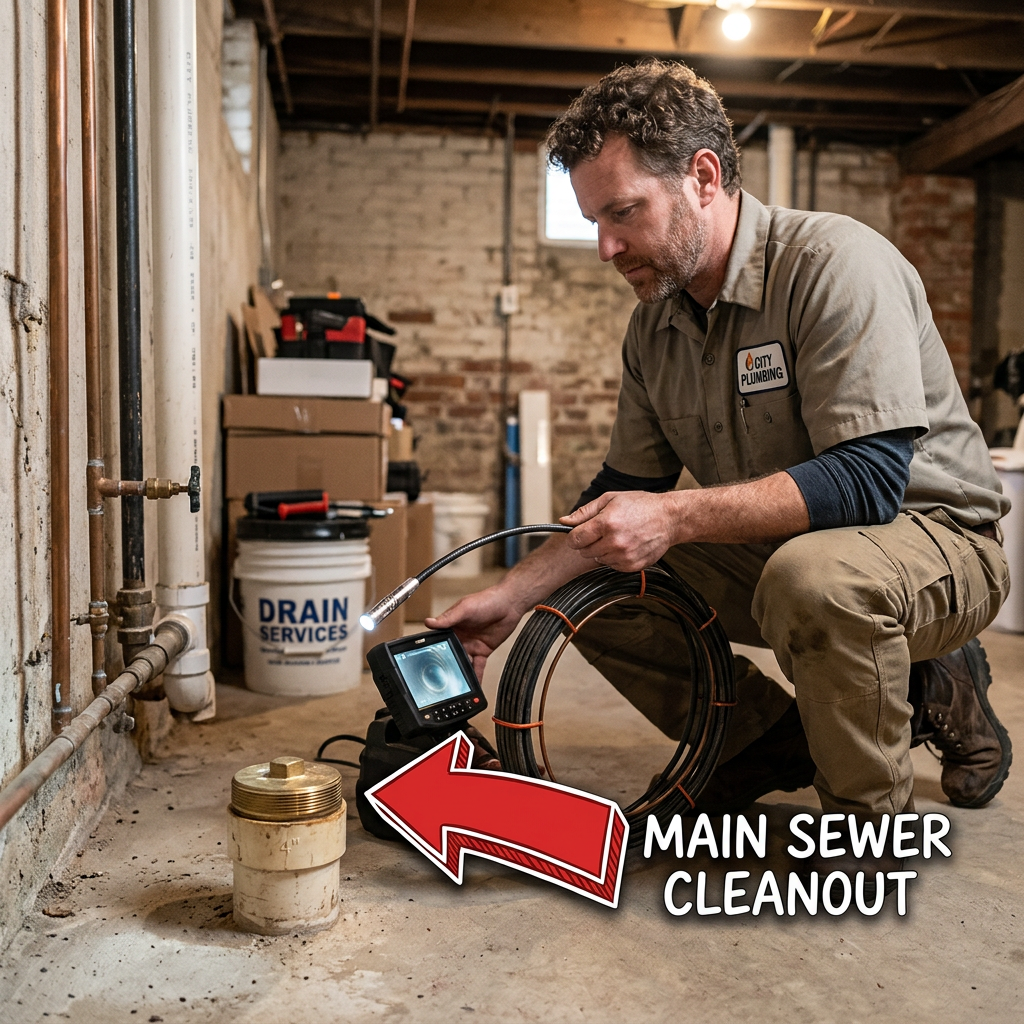
4. Find the main sewer cleanout
If you cannot find a permit or drawing, look for the main sewer cleanout.
A cleanout is a capped pipe that provides access to the building sewer. It may be located:
- Near an exterior wall
- Close to where the plumbing leaves the house
- Near a basement wall
- In a crawl space
- Along the side of the house
- Near a driveway or walkway
A clean out may appear as a small, short, plastic pipe with a rounded top cover. Clean outs can be white, green, black or gray in color. Depending on the type of property, some clean outs will be visible (above ground) while many will be buried nearly underground.
Typically, you’ll find the septic tank in the general direction that the primary sewer line runs away from your home. Carefully map out where the line goes from your house and identify possible entry points to get there.
It’s common to misjudge which bathroom drain feeds into the main sewer line. Most houses have one or multiple drains feeding into the main sewer line prior to leaving the home.
The route may change because of:
- A home addition
- A steep slope
- Large trees or rock
- A driveway
- An older plumbing layout
- A tank replacement
- A pump system
If you find a cleanout, do not remove it unless you know it is safe and necessary. A plumber or septic professional can use the cleanout to help trace the line.
5. Look for access covers and risers
Walk around the property and look for septic access points.
A septic tank may have one or more covers. These covers can be made from:
- Concrete
- Plastic
- Fiberglass
- Metal
- Composite material
The cover may be visible, or it may be just below the surface. It may be hidden by grass, mulch, soil, or light landscaping.
You may also find a septic riser. A riser extends from the tank opening toward the surface. It makes future access easier because service workers do not have to excavate as deeply.
Your blog already covers this subject in Top Reasons to Choose a Septic Tank Riser for Your Home. That article explains the benefits and installation considerations for risers.
For this location search, the important point is simple: a riser or access cover may identify the tank. Do not open or disturb it just to confirm what it is.
6. Use the property layout as a guide
Septic systems need suitable space, so the tank is usually placed in an area that allows wastewater to move toward the drainfield.
Look at the general layout of the property:
- Where does the house sit?
- Which part of the yard is open?
- Is there a sloped area?
- Are there buildings, driveways, or ponds nearby?
- Is there a well that requires a setback?
- Does the property plan show a possible drainfield area?
Generally speaking, a septic tank will normally be placed closer to your residence than a drain field. A drain field requires significantly more available space as it could have multiple trenches or distribution lines.
You should NOT look for the drain field solely around the back door or the side of your home. The septic tank could be anywhere that provided an easy location at the time the system was installed (i.e., the front yard, side yard, etc.).
If you are able to locate the drain field first; this information can also assist in locating the tank. Normally, the tank would be sited directly down the middle of the area from which extends from your home to where the drain field is located.
For more background, read Septic Drainfield: How It Works, Warning Signs, and Care Tips. Use that article to understand the difference between the tank and the drainfield, but keep the focus of this article on finding the tank.
7. Do not rely on one yard clue
Homeowners often search for surface clues. These clues may help, but none of them proves that a septic tank is below the soil.
Possible clues include:
- Small depression
- Raised portion
- Strip of dug up dirt
- Newer patch of green
- Small entry plate
- Line that is running off of the home.
- Change in elevation of the yard
- Area has been fixed and does look different than the rest of the lawn
These clues can have many causes. A depression may result from normal soil settling. A greener section may be caused by sunlight, fertilizer, rainfall, or soil conditions.
Do not assume that a surface clue is the tank location until it matches other information, such as the permit, plumbing route, or a professional locating result.
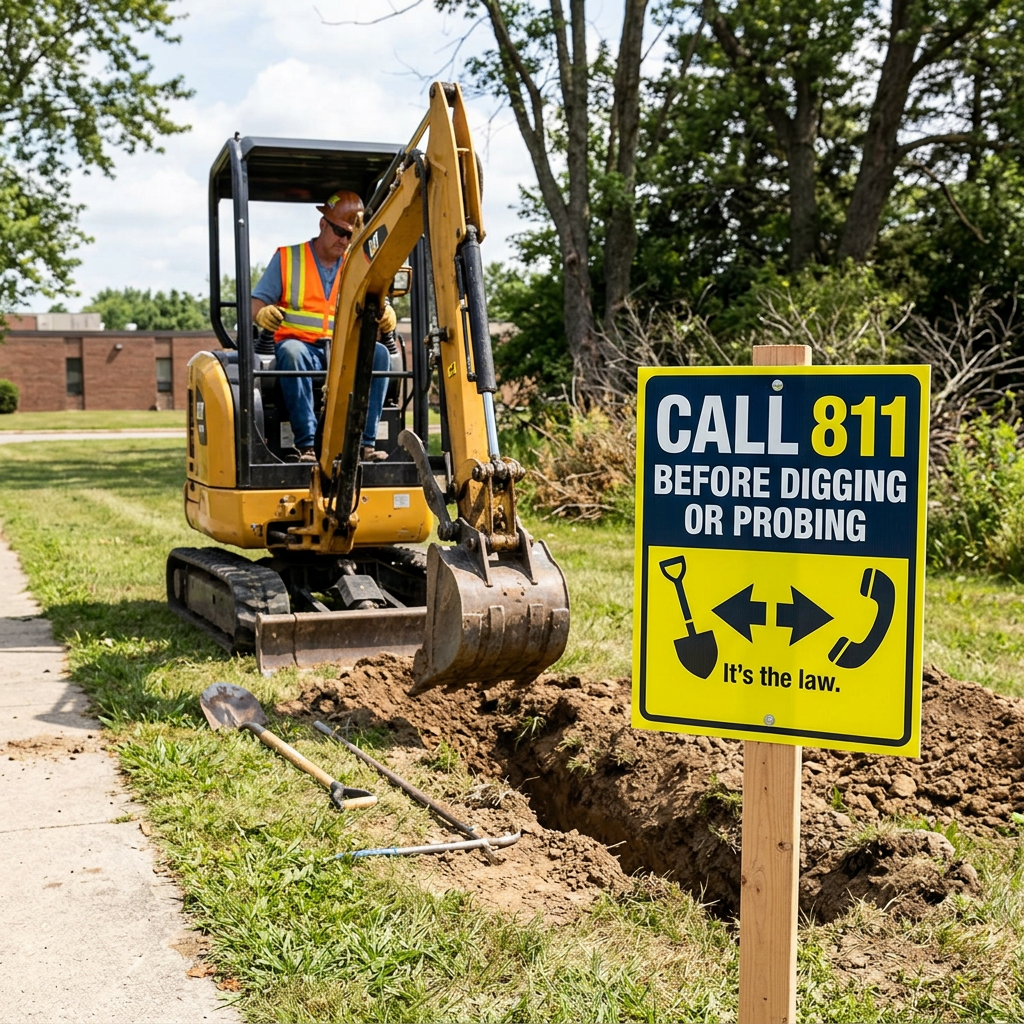
8. Call 811 before digging or probing
Call 811 before disturbing the soil.
The U.S. Department of Transportation recommends calling 811 before digging. You can also find state information through Call811.com.
Call 811 before:
- Probing for the tank
- Digging test holes
- Exposing a buried lid
- Installing a riser
- Planting trees
- Installing a fence
- Building a shed
- Driving stakes into the ground
811 helps utility companies mark underground lines. These may include gas, electric, water, communications, and other public utilities.
However, 811 may not locate:
- The septic tank
- The private sewer line from the house to the tank
- Private electrical lines
- Irrigation lines
- Other homeowner-installed lines
You may need a private utility locator as well as a septic professional.
Wait until the utility companies complete their markings before you disturb the soil.
9. Be careful with soil probing
A blunt soil probe may help identify the top of a tank when you already have a small search area. It should not be used as a substitute for records or professional locating.
If you use a probe:
- Work only in the most probable area.
- You are using a hand tool.
- Gentle pressure is being applied.
- Stop as soon as you feel “hard resistance.”
- You cannot hit the ground.
- Keep clear of marked utility lines.
- Do not dig around exposed pipes or broken covers.
- If you do not find it quickly, stop digging across your whole lawn.
A hard surface may be a tank, a pipe, a rock, a utility line, or construction debris. Probing too aggressively can damage a buried component.
If you cannot find the tank after a few careful attempts, stop and contact a septic professional.
10. How to find your septic tank when records are missing
A professional can often locate a buried tank faster than a homeowner working without equipment.
A septic company may use:
- Electronic pipe locators
- Drain-line tracing tools
- Probes
- Ground-scanning equipment
- Cameras
- Property record research
- Measurements from the home
- Specialized tank-locating equipment
Professional help is a good idea when:
- There are no records of the property’s existence.
- It appears to have been buried beneath the soil.
- There are tanks in addition to this tank on the residential property.
- A pump tank is part of the overall water treatment system.
- This was an original tank that had already been replaced.
- There are many potential locations for searching for other related information on this residential property.
- There is a possibility that the tank may be located underneath a lawn, garden or other landscaping features.
- It would be helpful to document the general area where it is located as you prepare for selling your home.
Before scheduling service, ask:
- Is tank locating included in the service?
- Is digging included?
- Does the company mark the location afterward?
- Do they provide photographs?
- Will they create a simple sketch?
- Is the charge flat-rate or hourly?
If you need to find the tank before pumping, ask whether the pumping company also offers locating services. The current location of the tank can affect the final service price, especially if the lid is buried.
11. Never enter or leave an open septic tank
A septic tank is not a safe place for a homeowner to enter.
The tank may contain toxic gases, flammable gases, and air with too little oxygen. The opening also creates a fall hazard.
The Occupational Safety and Health Administration provides confined-space safety guidance.
Never:
- Enter a septic tank
- Lean over an open tank
- Use a flame near a tank opening
- Leave an open lid unattended
- Allow children or pets near an open tank
- Stand on a cracked or damaged cover
The Washington State Department of Health recommends securing septic lids. If you uncover a damaged lid, keep everyone away from the area and call a qualified professional.
12. Mark the location after you find the tank
Once you confirm the septic tank location, make a record for future use.
Take photographs from several directions. Measure the distance from permanent objects, such as:
- House corners
- Exterior walls
- Driveways
- Property fences
- Large permanent structures
Save the measurements with your home documents. Keep a copy on your phone or computer.
You can also place a small, removable marker near the tank. Do not install anything that prevents future access.
If you have the system serviced, ask the company to confirm the tank location in writing. If the property has a pump tank, distribution box, or multiple access points, record those locations too.
A clear map can save time during future inspections, pumping, repairs, or property sales. Your septic tank pumping guide explains why knowing the access location is useful during service.
Frequently asked questions
How far is a septic tank from a house?
Typical distances vary based upon property size and type of septic system installed. The typical septic tank is located fairly close to the house; however, there may be various reasons why it could be further away such as, sloping land, additional structures added to the property, poor soils, driveways, etc. Therefore, rather than using an estimate of distance, the best way to determine where your septic tank is located is to look at your property plan and follow the path of the pipes.
Does 811 find septic tanks?
In general, yes. Typically, 811 will identify the locations of most underground utility lines for the homeowner. However, typically 811 does not identify individual private septic systems or the private sewage line extending from the home to the septic tank. In order to find these items, you would need to hire a septic company or a private locating firm.
Do all septic tanks have visible lids?
No. Many times the lids of septic tanks are buried under sod/grass and/or dirt. Other types of lids include those with risers that elevate the lids closer to grade level. Also, older tanks tend to be particularly hard to identify when there is insufficient documentation about them.
Can I use a metal detector to find a septic tank?
Yes, a metal detector may detect the presence of metal parts/accessories on some septic tanks. However, the majority of modern septic tanks utilize non-metallic materials such as concrete, plastic or fiberglass for their lids. Therefore, a metal detector cannot be relied upon as a means to locate all septic tanks.
How do I know whether I found the tank or the drainfield?
Typically, your septic tank will be closest to your house and connected directly into the primary sewage line running to your home. The drain field will generally be located further down slope from your home and may take up more space. Contacting a local septic professional or looking at your property map will help you verify what you have discovered.
Is it safe to remove a septic tank lid?
Unless you have experience with working around septic systems and a background in plumbing or engineering; do not attempt to lift the cover off of your septic tank. Gases emitted from the tank can be hazardous to your health and falling into the tank is extremely dangerous.
Should I install a riser after finding the tank?
A riser may make future access easier, but local rules and the tank design must be considered. Ask a qualified septic professional whether a riser is suitable for your system. You can read more in Top Reasons to Choose a Septic Tank Riser for Your Home.
Final thoughts
To locate your septic system, you will need to use multiple resources. Begin by using your local septic permit, as-built drawings, and documents from the time you purchased your home. Next, follow the main sewer line until you find an access cover or riser.
Before you dig or probe the soil call 811. Utility markings are not usually placed on the actual septic tank. If you still cannot locate the tank consider hiring a professional who specializes in septic systems and has the necessary tools to locate it.
Once you have located the septic tank record its location and always ensure the access area is clear. It may take just a couple of photos and some simple measurements; however, this may save you the frustration of looking again.
Keep your septic system working smoothly. Try Septifix today.
Check the current Septifix price here.
Affiliate disclosure: This may be an affiliate link. We may earn a commission if you make a purchase, at no extra cost to you.

Disclaimer
This article provides general information about finding a septic tank. Property layouts, septic designs, local regulations, and record-keeping practices vary. Contact your local health department or a qualified septic professional for advice about your specific system. Never enter a septic tank or leave an open access point unattended. Knowing how to find your septic tank can save time, prevent unnecessary digging, and make future septic service easier.
Related Posts