Septic Tank Size Calculator: How to Choose the Right Tank Size for Your Home
There are several critical considerations involved in choosing the right septic tank size prior to installing a new septic system or replacing an old system. An incorrectly sized tank can be detrimental to your overall system; an improperly sized tank can lead to rapid accumulation of solids, which in turn results in premature discharge of untreated wastewater into the drainfield with inadequate settling time. Conversely, selecting a tank that is larger than required will result in additional cost without addressing many potential problems with the overall system design.
In this article, we will show homeowners how they can utilize a septic tank size calculator to determine an estimated size for their septic tank. The article will cover relevant information including the number of bedrooms per home, daily wastewater flow, typical septic tank sizes available on the market today, local ordinances and codes, drain field design and layout, total installation costs, and ongoing maintenance.
Again, it is very important to note that while these calculators provide a planning estimate, your State or Local Health Department determines what constitutes an “approved” system design.
Affiliate disclaimer: This article contains affiliate links. If you purchase a product through one of these links, we may earn a commission at no extra cost to you. Our recommendations are based on the information available at the time of writing. An affiliate relationship does not replace independent research, professional advice, or local septic regulations.

Septic Tank Size Calculator: Quick Comparison
The table below gives a general planning range. It is not a national code table. Local requirements may call for a different tank size based on bedrooms, expected wastewater flow, soil conditions, fixtures, and the type of septic system.
| Home size | Common planning range | Typical starting point | Important note |
|---|---|---|---|
| 1 to 2 bedrooms | 750 to 1,000 gallons | 1,000 gallons | Local codes may set a minimum capacity |
| 3 bedrooms | 1,000 to 1,250 gallons | 1,000 or 1,250 gallons | Confirm the required design flow |
| 4 bedrooms | 1,250 to 1,500 gallons | 1,250 or 1,500 gallons | Extra fixtures may affect the result |
| 5 bedrooms | 1,500 to 1,750 gallons | 1,500 gallons or more | Larger homes may require additional capacity |
| 6 bedrooms | 1,750 to 2,000 gallons | 2,000 gallons | Some rules add capacity for each bedroom above six |
If your goal is to support routine septic care after confirming the correct tank size with a local professional, you can review SeptiFix here. A septic treatment product should not replace pumping, inspection, repairs, or compliance with local requirements.
How Does a Septic Tank Size Calculator Work?
A septic tank size calculator usually considers four main inputs:
- The number of bedrooms
- The expected daily wastewater flow
- The minimum tank capacity required by local rules
- The type and design of the septic system
Many communities use the number of bedrooms to estimate how many people a house could support. Today, there may be fewer than three people residing in a three-bedroom house. However, houses can potentially hold additional residents at some point. Therefore, bedrooms are used for community planning purposes.
Daily wastewater flow is another element to consider. Homes use large amounts of water through various appliances for toilet flushing, showering, doing laundry, washing dishes, preparing meals, and cleaning. Various homeowners’ guides recommend an average of approximately 60-75 gallons of water per person per day. This is simply an estimation used for long-range planning. Depending upon your jurisdiction’s ordinances and regulations, other assumptions may be used.
Using a calculator, you can compare the residence’s total calculated wastewater volume to the minimum required storage tank size. Before proceeding with installation or construction, each of these values must be reviewed and verified by your local permitting agency.
What Size Septic Tank Do I Need?
The answer depends on more than the number of people living in your house.
A common planning pattern looks like this:
- Smaller homes often use tanks of 1,000 gallons or more.
- Three-bedroom homes commonly use a 1,000- to 1,250-gallon tank.
- Four-bedroom homes may need 1,250 to 1,500 gallons.
- Larger homes may require 1,500, 1,750, or 2,000 gallons.
- Homes with unusually high water use may need a larger tank or a different system design.
These ranges are not universal requirements. For example, one state may set a minimum based on bedroom count, while another may calculate design flow from bedrooms and then apply a minimum tank volume.
New York provides one example of a bedroom-based approach. Its Appendix 75-A septic system rules base septic tank capacity on household bedrooms. The rules also explain how certain features, such as an expansion attic or garbage grinder, may affect the design calculation.
Your local health department may use a different approach.
Common Septic Tank Sizes Explained
500-gallon septic tanks
A 500-gallon tank is generally too small for many modern full-time homes. It may appear in special applications, older systems, cabins, or certain low-flow designs. It should not be assumed to meet current residential requirements.
750-gallon septic tanks
A 750-gallon tank may be permitted for a small home or low wastewater flow in some jurisdictions. However, many local codes use 1,000 gallons as a minimum for standard residential systems.
1,000-gallon septic tanks
A 1,000-gallon tank is a common residential size. It may serve a smaller home or a typical three-bedroom home, depending on local rules and site conditions.
1,250-gallon septic tanks
A 1,250-gallon tank may be used for a larger three-bedroom home or a four-bedroom home in some areas. It may also be selected when the household has higher water use.
1,500-gallon septic tanks
A 1,500-gallon tank is often considered for larger homes, higher occupancy, or systems with a greater expected design flow. It may also be required when local rules assign a higher capacity to four or five bedrooms.
1,750- and 2,000-gallon septic tanks
These larger tanks may be used for homes with five or more bedrooms, large households, or special design conditions. A larger tank does not automatically make a failing drainfield work properly. The tank and drainfield must be designed as one system.
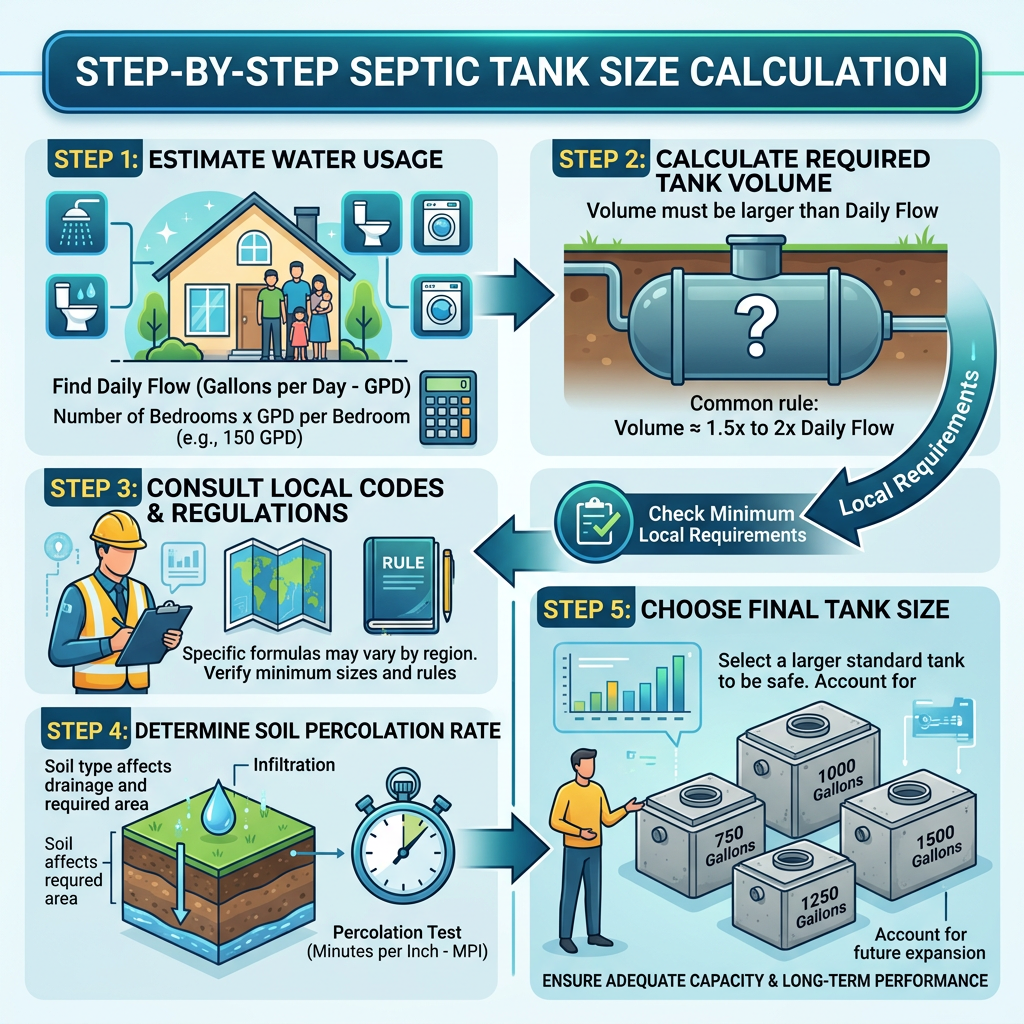
Step-by-Step Septic Tank Size Calculation
You can use the following process to create a rough estimate.
Step 1: Count the bedrooms
Start with the total number of bedrooms that could be used in the home. Include rooms that local rules may classify as bedrooms, even if they are currently used as an office, guest room, or storage area.
Do not assume that only the bedrooms currently in use count. A finished attic, basement room, or future expansion may affect the permitted design.
Step 2: Estimate daily wastewater flow
For a basic planning estimate, multiply the expected number of occupants by an estimated daily wastewater flow.
For example:
- Four occupants × 60 gallons per day = 240 gallons per day
- Four occupants × 75 gallons per day = 300 gallons per day
This estimate does not determine the final tank size by itself. Septic tanks need enough capacity to separate solids and allow wastewater to move through the system at a controlled rate.
Step 3: Check the local minimum tank size
Your state or county may require a minimum tank capacity based on bedrooms or calculated flow. Contact the local health department, environmental health office, or permitting authority before buying a tank.
The EPA septic systems guidance page explains that proper septic planning depends on design, installation, operation, maintenance, and local conditions. The EPA does not provide one universal tank size that applies to every home in the country.
Step 4: Account for special fixtures
Certain fixtures may increase the expected wastewater flow or change the design.
These may include:
- Garbage disposals
- Large soaking tubs
- Multiple showers
- High-capacity washing machines
- Additional kitchens
- Home businesses
- Guest houses
- Finished basement areas
- Frequently used hot tubs or spas
A garbage disposal can add food solids and increase the load on the septic tank. Some local rules count a garbage grinder as an additional bedroom or require additional treatment.
Step 5: Confirm the drainfield design
The drainfield must be able to accept and treat the liquid leaving the tank. Soil type, groundwater depth, slope, lot size, setbacks, and the available replacement area can all affect the system design.
A correctly sized tank cannot compensate for unsuitable soil or an undersized drainfield.
How Soil and Property Conditions Affect Septic Tank Size
The septic tank is only one part of an onsite wastewater system. Before approving a system, a local authority may require a site evaluation or soil test.
Important site factors include:
Soil texture
Sand, loam, clay, and fractured rock handle wastewater differently. Sandy soil may allow water to move quickly, while clay may slow absorption. Extremely fast movement can reduce treatment, while slow movement can cause ponding or system failure.
Groundwater and bedrock
A high groundwater table or shallow bedrock may limit the depth of the system. It can also require a raised bed, mound system, pressure distribution system, or another alternative design.
Slope
A steep property may need pumps, multiple drainfield zones, or special grading. The tank size may remain similar, but the overall system can become more complex.
Setbacks
Local rules may require minimum distances from wells, property lines, buildings, streams, ponds, driveways, and property boundaries. If the usable area is limited, the approved design may need to change.
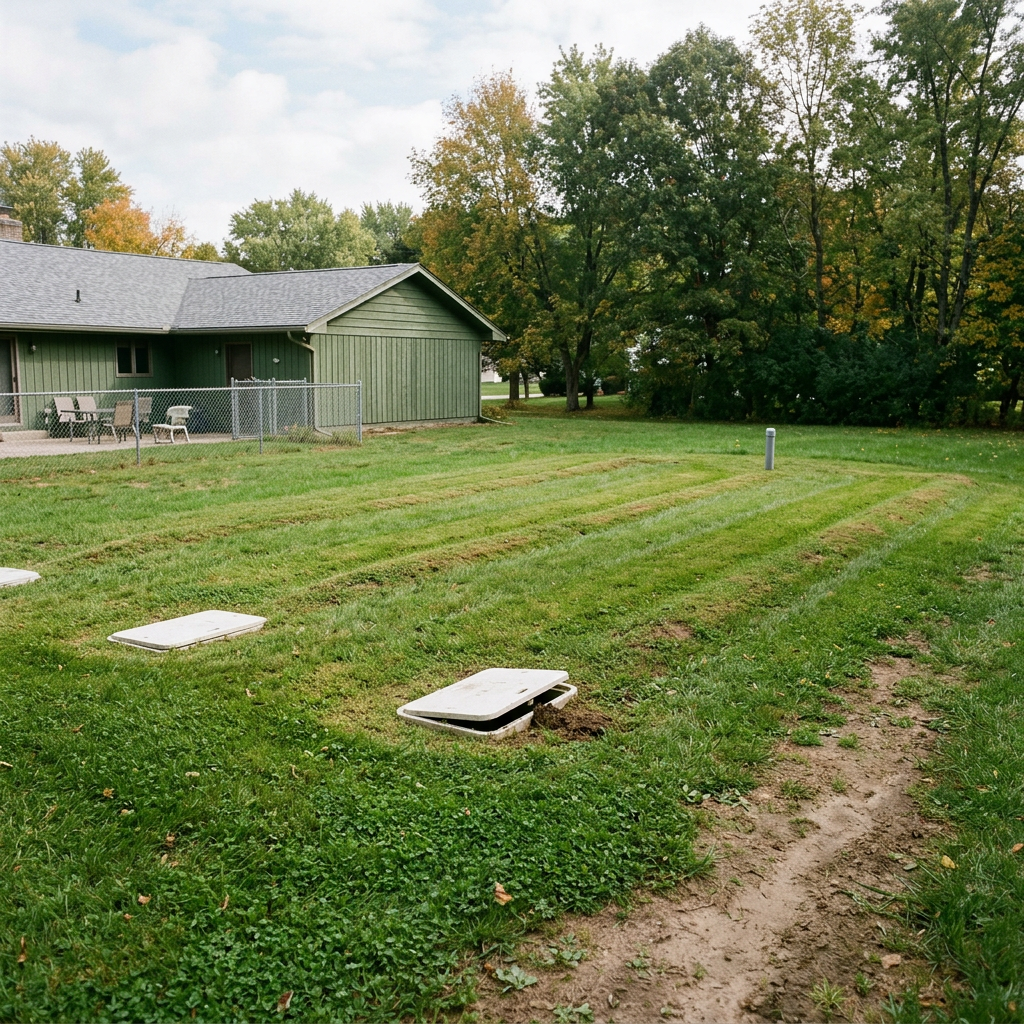
Drainfield area
A larger home may produce more wastewater, which can require more drainfield area. The tank and drainfield should be planned together rather than selected separately.
The Massachusetts Title 5 septic program is one example of a state regulatory system that covers septic design, permitting, and inspection. Other states and counties have their own requirements.
Septic Tank Size Examples
Example 1: Two-bedroom home
Although a single family in a two-bedroom house will likely use a relatively small amount of water (with possibly two to three people), the municipal code may require a 1000-gallon minimum storage capacity. Therefore, although the household’s present consumption is minimal, a smaller-than-required tank would most likely be denied.
Example 2: Three-bedroom home
Using a general planning range, a three-bedroom house occupied by four individuals produces approximately 240 to 300 gallons of wastewater daily. Depending upon local codes and site evaluations, a 1250-gallon or larger tank may be considered.
Example 3: Four-bedroom home
The water tank size for a four-bedroom home could be in the range of 1250 to 1500 gallons. The size of the tank needed could increase further depending on whether the house contains a garbage disposal, an additional kitchen, or a larger family.
Example 4: Six-bedroom home
The water tank size for a six bedroom home would typically fall into a range of 1750 to 2000 gallons. Homes that have seven or more bedrooms may also be subject to increasing requirements depending on state regulations.
These examples are for planning only. Do not use them as a permit application or purchase specification.
Is a Larger Septic Tank Always Better?
Not necessarily.
A larger tank may provide more capacity, but it does not solve every septic problem. The system may still fail because of:
- A clogged outlet filter
- A damaged baffle
- A blocked pipe
- Poor soil
- A saturated drainfield
- Excessive water use
- A broken pump
- Flooding or surface water entering the system
- Lack of pumping and inspection
A larger tank may also cost more to transport and install. Oversizing can sometimes reduce the wastewater flow rate through the tank, but the system still needs a design that meets local requirements.
The best tank is the one that matches the approved design, expected flow, site conditions, and future use of the property.
Septic Tank Size and Installation Cost
Tank size is one part of the total project cost. Other expenses may include:
- Soil testing
- Engineering or site evaluation
- Permits
- Excavation
- Tank delivery
- Tank installation
- Pipes and risers
- Distribution boxes
- Pumps and controls
- Drainfield construction
- Landscaping and restoration
A larger tank may increase the price of the tank and excavation, but the drainfield and site conditions often have a greater effect on the final cost.
For a broader cost discussion, read our guide to septic system installation cost.
Maintenance After Installation
Maintenance of your septic system is just as important as proper installation.
According to the Environmental Protection Agency (EPA), it is recommended to have a conventional septic system inspected by a certified inspector at least once every three years. In addition, many residential septic systems require maintenance in the form of pumping the tank every three to five years; however, this frequency can vary based on factors including the size of the tank, the number of people living in the house, the volume of wastewater generated, and the buildup of solids.
Read the EPA’s Septic System Care and Maintenance guide for general maintenance advice.
You can also review our septic system maintenance checklist and our guide to septic tank inspections.
Avoid flushing wipes, paper towels, grease, harsh chemicals, and other materials that can damage the system or increase the solids load. Keep heavy vehicles away from the drainfield, and direct roof runoff and sump pump discharge away from the system.
For more information about the drainfield, see our guide to how septic drainfields work.
Key Takeaways
- The size of a septic tank is estimated by a septic tank size estimator; it is not an approval for a building permit.
- Bedroom count is commonly used to estimate the number of potential occupants.
- Another significant sizing factor is the estimation of daily wastewater flow.
- Typically, most residential tanks range from 1,000 to 2,000 gallons; however, local regulations usually differ from what is typical.
- Factors such as soil type, drainage slope, depth to groundwater, property setback distances, and required drainfield size will also affect what is permitted as part of the system design.
- Potential increases in wastewater flow could occur within the residence due to additional factors (e.g., garbage disposal systems, guest house or apartment, secondary kitchen space).
- Larger tanks do not provide a fix if the drain field is failing or is too small.
- You should always confirm the design with both your local health department and a licensed/qualified septic installer before installation.
- Regular inspections and pumping remain necessary even after initial installation.
Septic Tank Size Calculator FAQ
Which septic tank size is the most common?
1,000-gallon tanks are a common residential septic tank size; however, they typically serve smaller homes (one or two bedrooms) and occasionally three-bedroom homes. The larger the home, the greater the tank size will need to be to meet local codes regarding approved tank sizes.
Will a 1000-gallon septic tank work well for a 3-bedroom home?
The answer depends on the county you live in. In some counties, a 1000-gallon or even a 1250-gallon tank may be sufficient for a 3-bedroom home. This depends on local design flow, household usage, fixtures, and local regulations.
How many bedrooms can a 1000-gallon septic tank accommodate?
There is no single answer to this question. Depending on local codes, some may allow a 1000-gallon tank for either a 2- or 3-bedroom home. Other areas may have stricter standards for septic tanks. It is always best to check your local code before purchasing a tank.
Do the number of bathrooms factor into determining how big of a septic tank I need to purchase?
Yes, additional bathrooms may increase your expected water usage. However, in many areas, the primary method of measuring residential septic tank use is by bedroom count. Even though your kitchen(s), bath(s), tub(s), and other high-usage fixtures may consume more water than average, these items are considered when designing your system.
Can I simply use a septic tank size calculator versus having someone professionally evaluate my property?
While a calculator can provide an understanding of the factors that go into determining the right-sized tank for your property, a calculator alone cannot assess soil type, groundwater levels, slopes, setback restrictions from neighboring properties, or required space around the drain field, to name just a few. Therefore, the determination of your tank size and design must ultimately be made by a qualified professional.
How often should I pump out my septic tank?
Typically, septic tanks are pumped every 3-5 years. However, the recommended timeframe will vary depending on tank size, the number of people living in the home, water usage, and sludge buildup. Your inspecting professional will provide recommendations based on your specific situation.
Does having a larger septic tank make regular maintenance easier?
No. Regardless of how much waste volume a tank can store, regular maintenance is essential to maintaining both the integrity of the drain field and preventing backups.
Before purchasing a septic tank, what do you need to do?
First, contact the county or city’s health department or permitting office. Then ask them about the minimum tank size allowed, if they have any requirements for on-site testing prior to installation, which tank designs are permitted, how far from property lines the tank must be installed, and who has to sign off on the installation plan (e.g., a licensed designer/installer).
Give your septic system extra support with SeptiFix, an easy-to-use monthly tablet designed to help maintain a cleaner, healthier tank between professional inspections.

Related Posts